
 Chloe Marsh
Medical Aesthetician · June 16, 2026
What makes me furious is the garbage the industry sells you to ‘fix’ what Ozempic does to your skin.
And not one of those fixes can work, for a reason that’s sat in the medical literature for decades.
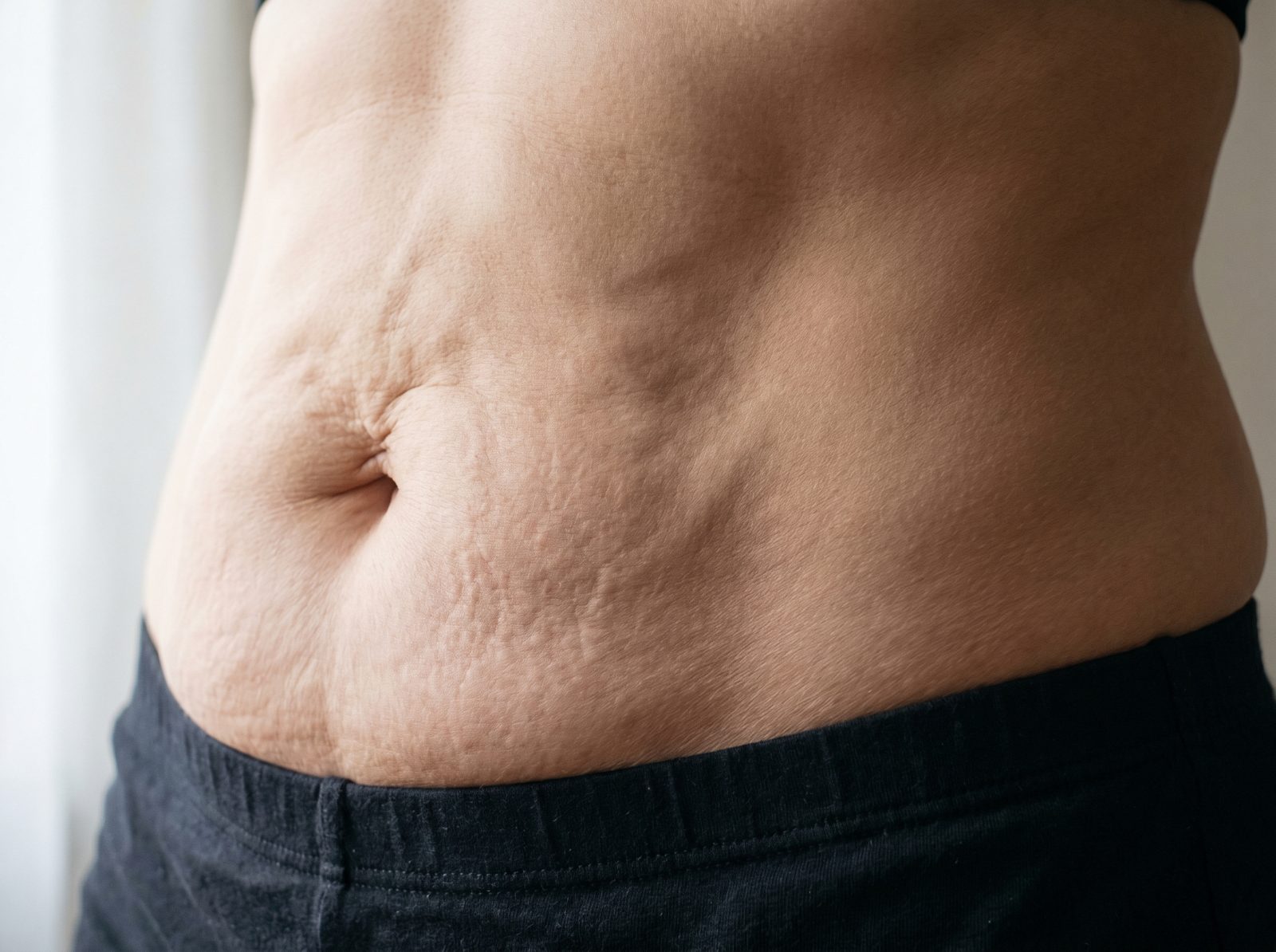
For twelve years I’ve treated loose skin — thousands of women, most after weight loss — so I know every promise the industry makes about that skin, and how few of them hold up.
This year I started losing weight myself, on Mounjaro. The moment the algorithm worked out what was happening to my body, my feed filled with “cures” — more confident garbage than I’d ever seen in one place, starting with an ad for “marine elastin peptides that restore the elastin you lost.”
Let me save you the money, one lie at a time.
this one.

The offending ad, exactly as it ran in my feed. (My notes in red.)
Here’s what every cream company hopes you don’t know: your body essentially stops making new elastin in adulthood. You can’t eat or rub on someone else’s elastin — a fish’s, here — and have it become your skin’s. Swallowed, it breaks into amino acids; slathered on, the molecule’s far too big to cross your skin. You cannot buy elastin. Full stop.
Both sit on the surface. The looseness is a structural problem millimeters below, where they can’t reach — an oil just gets there in a nicer bottle. And the “Ozempic skin” serums that showed up the week the shots got popular? Same surface product, a panicked label, double the price. Wrong floor of the building, all of them.
The one pretending to be the responsible take. Whether your skin holds comes down to your age, your genetics, how much you lost, and how long it was stretched. Not your willpower. Telling you it’s your fault is just one more way to sell you something.
the con.
All the ads I’ve seen — and every product the skincare industry is suddenly selling to women on GLP-1 — they all collapse into the same lie. Not the depth. Not the ingredient. Not the brand. Loose skin after weight loss is not an ingredient problem, and every company selling you one online is either lying to you or doesn’t understand what’s actually broken.
Once you understand this, you’ll never fall for false claims again
So here’s what’s actually broken. Firm skin is held up by two proteins in the dermis: collagen gives it structure and density; elastin gives it stretch and recoil — the snap-back. Lose weight fast and that support stretches thinner than the body can rebuild it. It gives way, the surface sinks, and the skin goes loose. The structure failed, not the surface.

And it won’t come back on its own: adult skin barely makes new elastin, so waiting won’t rebuild it. The structure has to be triggered to regrow. Which leaves one real question — what does that?
microneedlingOnce you understand how it works, the rest of the noise goes quiet. Here’s what it does:
It creates controlled micro-injuries — tiny, precise tears your body treats like any wound it can heal.
Blood and repair signals rush the spot. Your body starts producing collagen and elastin fast, exactly where the structure gave way.
You’re not delivering collagen onto your skin. You’re triggering your body to manufacture its own.

And what the body builds this way is permanent — structural collagen and elastin that stays.
None of this is theory. Microneedling has been studied for over twenty years, in dozens of clinical trials. The one that matters used plain mechanical microneedling — no heat, no RF — with serum worked into the channels it opens. Treated skin came back:
Girão et al., 2024 — measured at three months
“Denser” is the word that matters — the structure physically filling back in. Not the surface smoother for an afternoon.
Mechanism documented in Singh & Yadav 2016; Xu 2025.
I watched women try this two ways.
Microneedling itself was never the hard part — the science is settled. The hard part was the question every woman eventually asked me: how do I actually get this done?
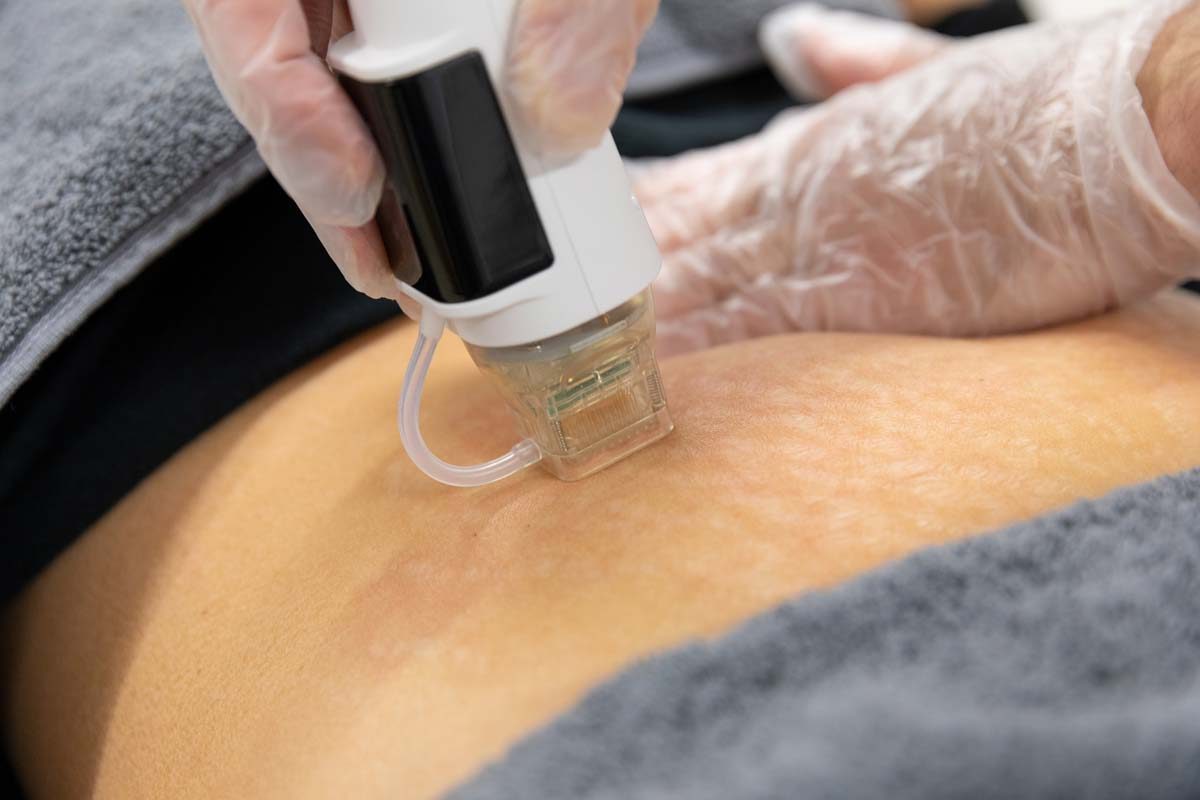
At a clinic
✓ It works — I ran these sessions myself for years.
✗ But I watched the calendar win, over and over. A session slips, then another; the cost climbs, and a day of redness costs her time she doesn’t have. By the third visit most women were gone — half-finished, nothing to show for what they’d paid.
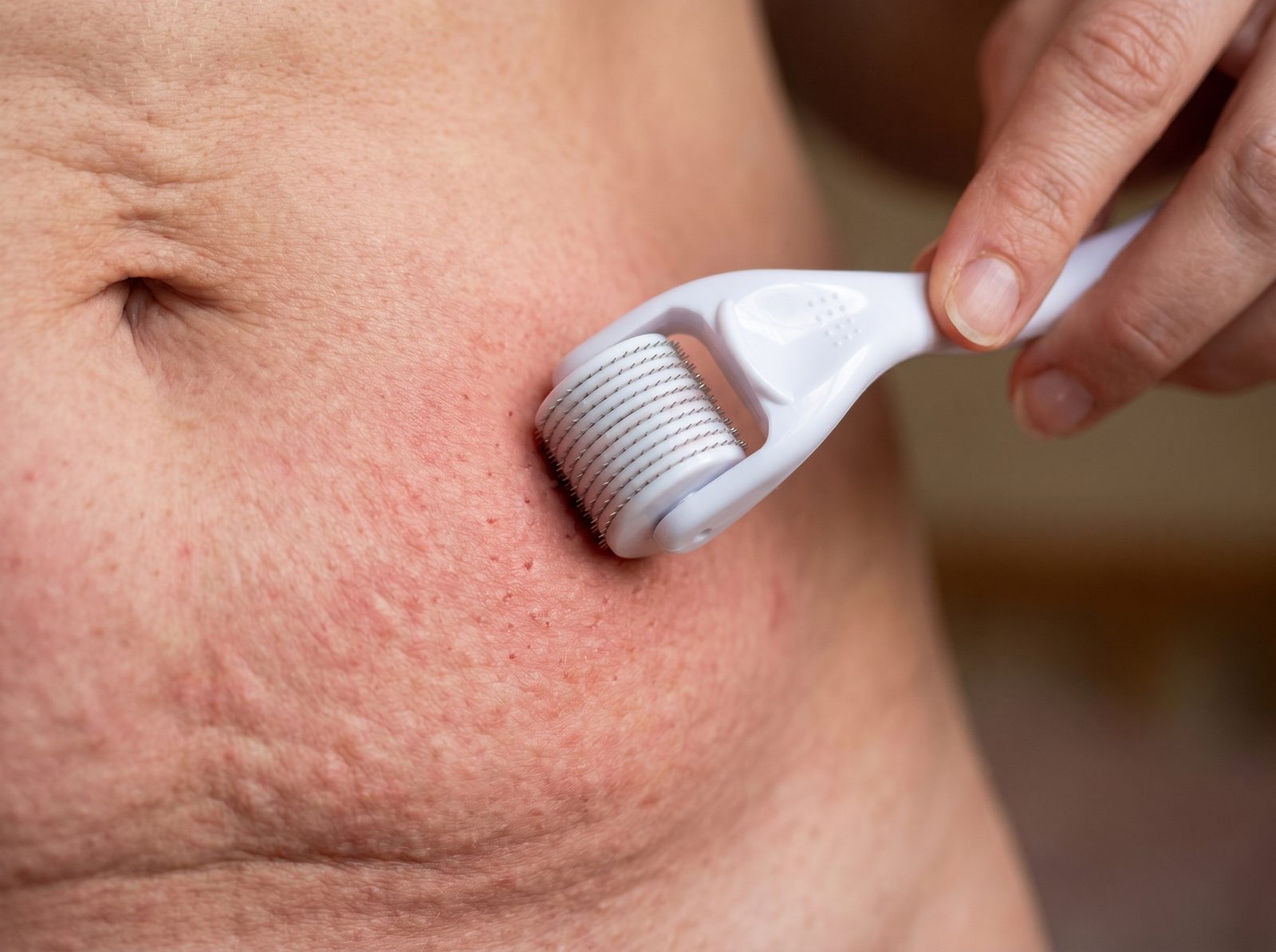
On her own
✓ Cheaper, and on her schedule. I understood the pull.
✗ But I was the one she came to when it went wrong — the too-deep scar, the serum that burned, the roller never quite clean. No one to set the depth, no protocol, no one to answer for it. Just her, guessing, on the most delicate work there is.
Every woman ended up stuck between the two — the option no one could sustain, and the one no one should risk.
What I used on myself while losing the weight — and have recommended to my clients ever since.
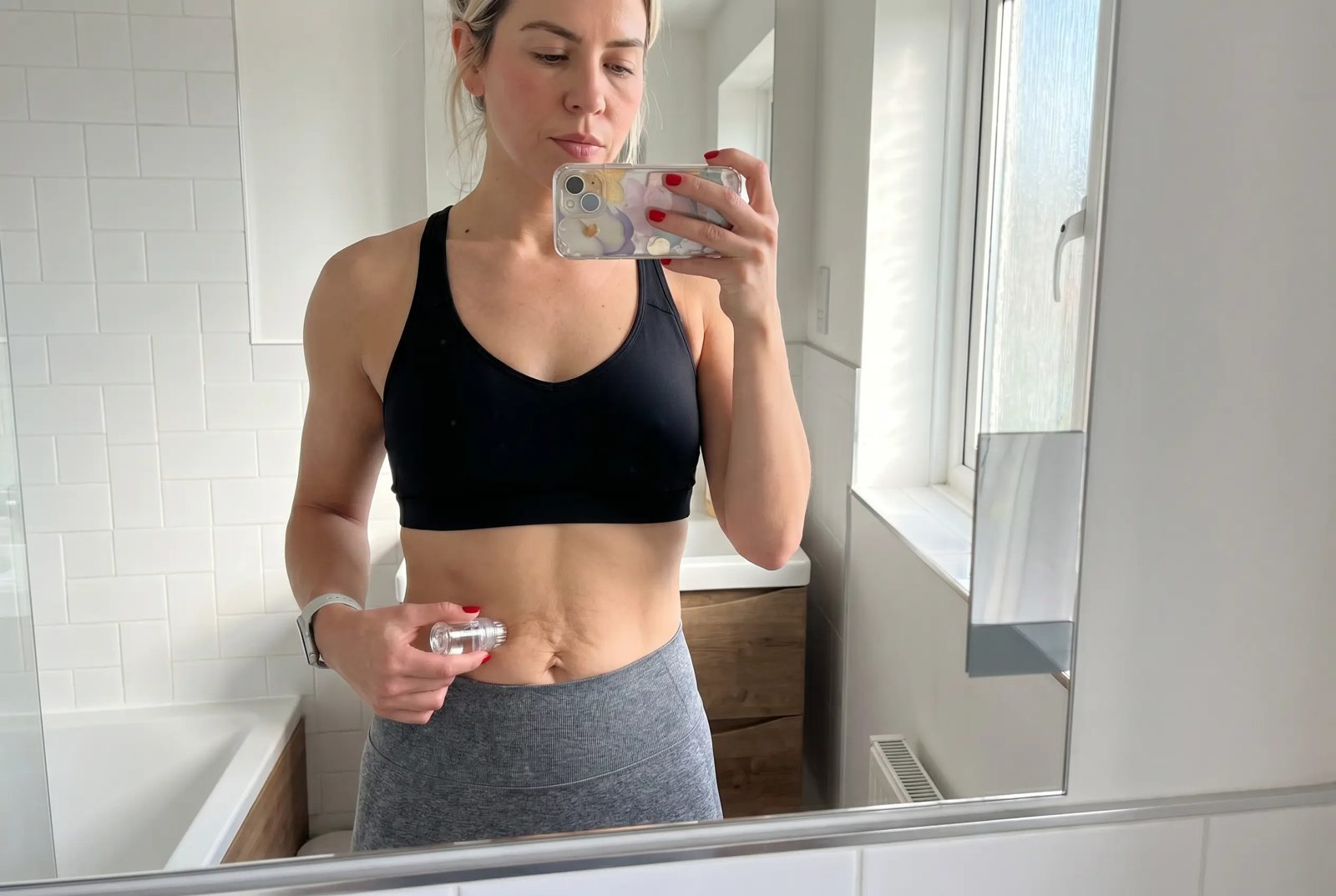
At home, the clinical version
✓ Built by an aesthetician, from the clinic treatment itself
✓ Single-use and sterile — none of the infection risk of a reused roller
✓ A serum made for needled skin — none of the actives or fragrance that burn
✓ A set protocol — nothing to guess at
✓ No appointments, no consultations
✓ Backed by a 90-day guarantee
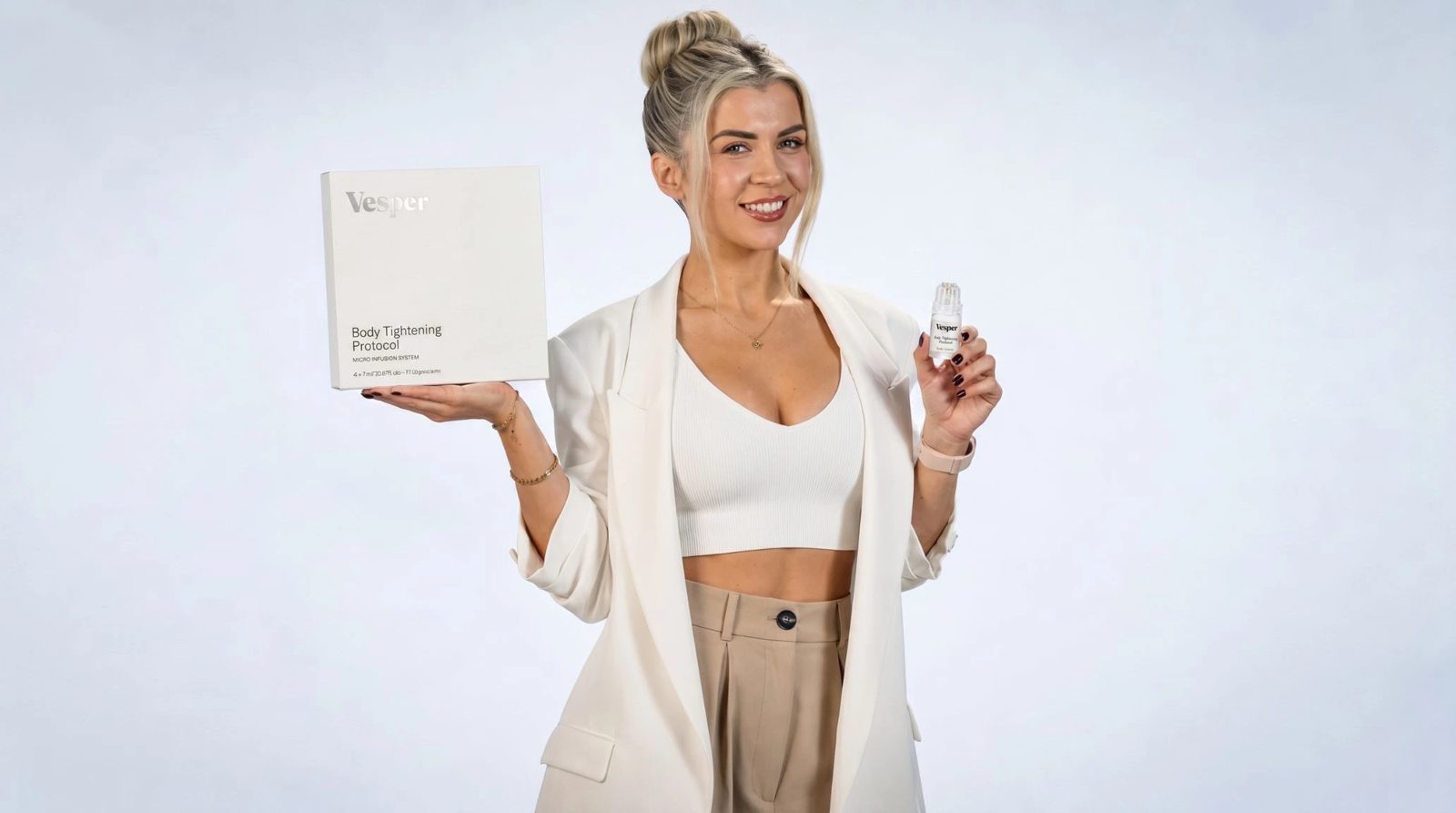
If you want to understand the full protocol — or you’re ready to try it — here’s the page.
How much it helps depends on where you’re starting.
The honest version — it depends on where your skin is now.
Still losing, or first signs
The best position to be in. Used while the weight’s still coming off, microneedling keeps your collagen and elastin building with you instead of falling behind — and because it works on stretch marks too, those soften as you go. Don’t slow your loss to spare your skin; keep your doctor’s pace and treat alongside it.
Mild-to-moderate laxity
Squarely what it’s for. As the structure rebuilds and the skin gains density, the loose, crepey look softens — the skin starts to sit like it belongs to you again.
Genuinely loose, even hanging a little
Here I have to be honest: microneedling doesn’t remove skin — it rebuilds the structure underneath it. As that support fills back in, loose skin firms and tightens — for some women, noticeably. It won’t make excess skin vanish. But it can make skin you’d written off look and feel like yours again.
Severe, true excess
Skin so far past its limit it hangs no matter what’s underneath. There’s a point where rebuilding the structure isn’t enough, and that’s the one case where surgery enters the conversation — a genuine last resort, not a first move. But here’s what I’ve watched for twelve years: most women, even the ones sure they’d need surgery, get results good enough to take it off the table.
I’ll let the women who’ve used it tell you the rest.
“I had a fold on my lower belly I’d accepted for years. It doesn’t magically disappear — let me be clear. But it lies flatter now, with real tension in it instead of dead hang, and it stopped folding over my waistband when I sit.”
“I’ve returned more skincare than I’ve kept, so I expected to send this one back too. I didn’t. My thighs had gone soft as the weight came off; now there’s substance under them again, and a real bounce when I press them that wasn’t there before.”
“I did everything right and still ended up hiding my stomach from my own husband. I won’t pretend a device fixed how I felt overnight. But the loose skin has tightened, the crepey look has faded, and a few weeks ago I stopped pulling my shirt away from my body when I sat down. I didn’t notice I’d stopped until he pointed it out.”
You can see the full protocol they’ve been using — along with more of their stories and hundreds of reviews.
Where this leaves you
You know what’s broken now — and what actually rebuilds it.
The one cost no one mentions is time. Every month you wait — for it to firm on its own, or for the next thing you order to turn out to do nothing — the structure underneath keeps thinning. That’s the part you don’t get back.
So where does that leave you?
Relevant studies mentioned
- Girão et al. (2024) — split-body microneedling RCT in striae: +216.5% elasticity, +34.3% dermal density at three months. PubMed
- Singh & Yadav (2016) — review of the microneedling wound-healing cascade. PubMed
- Xu et al. (2025) — histological collagen and elastic-fibre remodeling after microneedling. PubMed